Ce qui m’étonne le plus en parcourant les archives de Resonance FM, c’est la manière dont toutes ces initiatives s’articulent et se nourrissent mutuellement : des producteurs et productrices, des stations de radio, des festivals et des réseaux qui forment un écosystème vivant, au sein duquel les voix, les idées et les formes de création radiophonique circulent entre les langues, les nations et les frontières, dans une perspective profondément cosmopolite.
As I wander through the Resonance FM archives, what strikes me is how all these initiatives hold together and sustain one another. Producers, radio stations, festivals and networks form a shared, living ecosystem in which voices, ideas and forms of radiophonic creation circulate across languages, nations and borders in a profoundly cosmopolitan way.
Voici l’enregistrement de l’émission Drifting in the Resonance FM Archives du 11 novembre 2026.
* *
The first time I came to Resonance FM, in December 2024, I put my hands into boxes overflowing with cassettes and I recognized the name of several European capitals written on them.
I remember this cassette, here, on which was written : Prague, 1983.
I believed that Resonance was thus linked to Czechia in the 1980s… until the moment I discovered, later on, that it was more the archives of the London Musicians Collective… and more precisely cassettes of the musician Chris Cutler, from the band Cassiber.
* *
Listening to sound archives takes you elsewhere… to another city. And on this one it was written Aligre FM, a community radio in Paris.
* *
Listening to the radio and archives… is always a form of travel, whether through space or time.
There is a sense of displacement dans l’acte même d’écouter, in the heart of listening.
In June last year, when I was in Québec, I remember catching a program on Resonance FM from London that transported me all the way to Tallinn.
Voices of Tallinn, It was produced by Michael Umney, formerly of Resonance FM, in collaboration with other members of the Independent Community Radio Network.
* *
Following in the footsteps of Georges Perec et ses tentatives d’épuisement d’un lieu parisien, they sought to exhaust a place in Estonia by describing everything within their field of vision. Through the radio, they helped bring Tallinn to life.
* *
And on and on, one voice follows another, describing the places that make up this Estonian city.
And here, where I am, in this cosmopolitan city, the Resonance FM archives reveal connections and collaborations between community radio stations, linking cities across Europe and beyond.
Tuning in to the radio or listening to the station’s archives… each minute of broadcasting, each document, is in fact a portal to somewhere else, to another world.
For several years now, I have been listening to Radiophrenia, a Glasgow-based radio art festival that began in 2015. Traces of the festival can be found here in the archives, as Resonance FM has been rebroadcasting its programme since the festival’s very beginnings.
* *
I could follow Perec’s method, as well, describing what is here, and begin the infinite list of voices, collaborations, and relations with another radio stations.
But before venturing further into these radio and archives portals, perhaps we should, once again, obey the command to “Always historicise.”
This might help us understand the conditions of possibilities that made all these transnational exchanges and encounters possible.
And, for once, let us obey — not just anyone, but Fredric Jameson, and not just any injunction, but the call to return to the sources.
Let us return to the once upon a time. Il était une fois, Once upon a time, in 1998, a few members of the London Musicians’ Collective decided to launch a radio project called Resonance FM, experimenting with radio art during June and July.
* *
The day before the festival comes to an end, the 4th of July 98, there was a discussion about the history and the future of radio art in Britain.
* *
As I reflect on the history of Resonance FM, a radio station that has generated its own archive and, surprisingly, continues decades later to enable all kinds of encounters between producers and radio institutions, I am also trying to piece things together, to make sense of the history of sound creation and radio art.
* *
Lance Dann, formerly of Resonance FM, helps us trace the genealogy of these radio initiatives, drawing attention to the examples of Festival Radio in Brighton and Fresh Air FM in Edinburgh.
* *
Each document acts as a stepping stone, gradually expanding my understanding of the history of European radio art.
I’m also aware that, across the Channel, Festival FM was taking place in La Rochelle in the early 1980s, around the same time as CKRL’s Quinzaine de la radiophonie internationale in Québec.
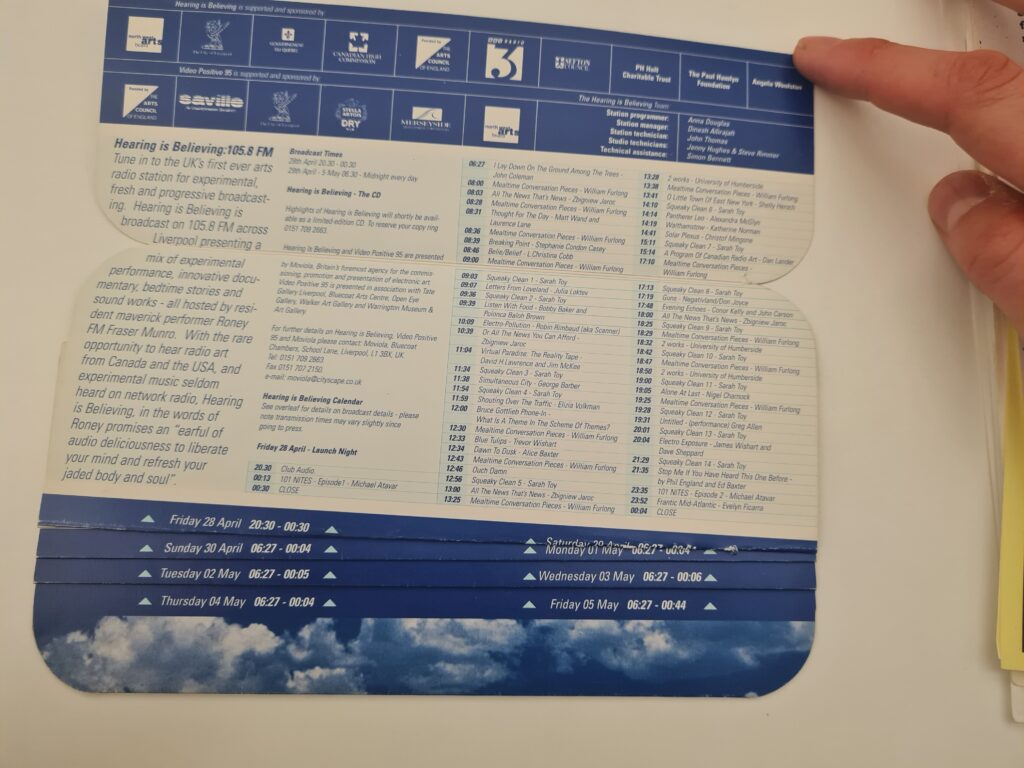
In the LMC archives at the LCC, I also came across traces of the radio festival Hearing is Believing, which took place in Liverpool in 1995.
* *
It’s international, but local first, and yeah ultimately international.
Perhaps… I’ll never really get to the bottom of it. But by digging where I am, I begin to get a sense of how things circulated: how this experimental phase spread, both before and after Resonance FM, and elsewhere across Europe, and how all this ferment eventually found its way back here, onto the airwaves of the station I’m speaking to right now.
* *
I’ll never really get to the bottom of it, and I’m thinking as well as the Third Coast Festival in Illinois…but for the moment, I am digging where I am.
And I’m constantly surprised by the connections that emerge between producers and radio stations in Europe and Resonance FM.
Here’s a CD from L’Atelier de création sonore radiophonique de Belgique, an organisation founded in 1996. This particular CD dates from 2003 and is titled “15 îles sonores = 2 archipels”.
* *
Here’s Miriane Rouillard, a flute player and sound artist from Québec City that now work for Avatar, an artist-run centre dedicated to sound art, which was connected to the Resonance FM Festival in 1998.
* *
And this, still on that 2003 CD, was a piece by the artist and writer Étienne Noiseau, one of the founders, alongside several collaborators, of the magazine Syntone, which covered radio art in France from 2008 to 2019.
* *
And look at this in the archive, a usb key for the radiophonic creation day in 2009.
* *
There’s a beautiful bouquet of some of the most important european sound artist of our time, brought together in 2009 for a 24-hour broadcast.
With almost five hundred audio documents on the USB stick, including contributions from Knut and a Robin Warren.
* *
There’s so many collaboration from around the world in the Resonance FM Archives.
* *
I’m constantly struck by the ways these worlds sustain one another: how networks and festivals bring together producers and stations, and how, in turn, an entire community of sound artists keeps a constellation of radiophonic institutions alive – each giving life to the others.
I’ll never really get to the bottom of it, and I’m thinking as well as Longueur d’ondes festival in France that exists since 2003… (cf. Oufipo. Faire communauté par la radio avec Loïc Chusseau et Delphine Chaudeaux (Pop’ Media), Yann Simon (Transistoc’h), Ariane Demonget et Etienne Noiseau (Résonances) et Claire Kachkouch Soussi à la modération.)
* *
And I’m thinking also of the Radia network, which I’m getting to know – a network that has been active since 2005, bringing together members from Belgium, Austria, Albania, Macedonia, Portugal, Germany, Bulgaria, Hungary, UK, United States, Canada, and so on.
* *
Each week, one station creates a show that’s shared across the Radia network… and it’s going on since more than 20 years…
Each radio station thus becomes an incubator for volunteers and engineers, who help one another grow into producers, who in turn support the station and become part of networks that they themselves help nurture and sustain for decades.
* *
And it is also possible for one radio station to act as an incubator for another, as was the case with Phaune Radio, a project that emerged in 2008 at Radio Grenouille in Marseille.
* *
In 2013, as Phaune Radio became a web radio station in its own right, Resonance FM rebroadcast Les Nuits de la Phaune, a wild, seven-part radiophonic journey into sound, music and nature.
* *
What strikes me, as I wander through these archives, is how all these initiatives hold together and sustain one another, forming a shared, living ecosystem, allowing voices, ideas and forms of radiophonic creation to circulate across languages, nations and borders, in a profoundly cosmopolitan way.
Shout-out to Resonance FM, EXTRA, the Independent Community Radio Network, and all the others keeping this tradition alive.
So, the Resonance FM archives are not simply the records of a radio station, but the traces of this wider community: a history of encounters, collaborations and mutual support, all gathered around the practice called “audio art” – something celebrated last September at the XMTR Festival.
Each one teach one.
And these archives still have so much to teach us.