Nous sommes tous connectés, d’une manière ou d’une autre — au passé, au présent et les uns aux autres. Il y a quelque chose à déterrer dans la culture du passé comme du présent. En creusant sous la surface des archives, nous pouvons commencer à saisir les nombreuses façons dont nous avons été connectés — et comment nous nous relions.
Pendant environ un siècle, de la fin du XIXe à la fin du XXe siècle, le téléphone fixe était le principal moyen de communication.
Voici l’enregistrement de l’émission Drifting in the Resonance FM Archives du 28 octobre 2026.
* *
We are all connected, one way or another — to the past, to the present, and to each other. There is something to unearth in the culture of both past and present. Digging below the surface of the archives, we can begin to grasp the many ways we have been connected — and how we relate.
For about a century, from the late 19th to the late 20th century, the landline was the principal means of communication.
My grandparents called each other from Québec all the way to the Lower North Shore; my parents did it almost coast to coast, all the way from Québec to the Mackenzie River in the Northwest Territories, and so on. Which family living in the last century did not keep in touch by telephone line, wherever they happened to be?
The landline has been used to convey all sorts of information – factual information, simply to say : “yo, whatup, I still exist”, “I’m in good health”, and “I can’t wait to see y’all again”.
And telephone lines have also been used for more serious matters – such as national security – if we think, for example, of the famous red telephone.
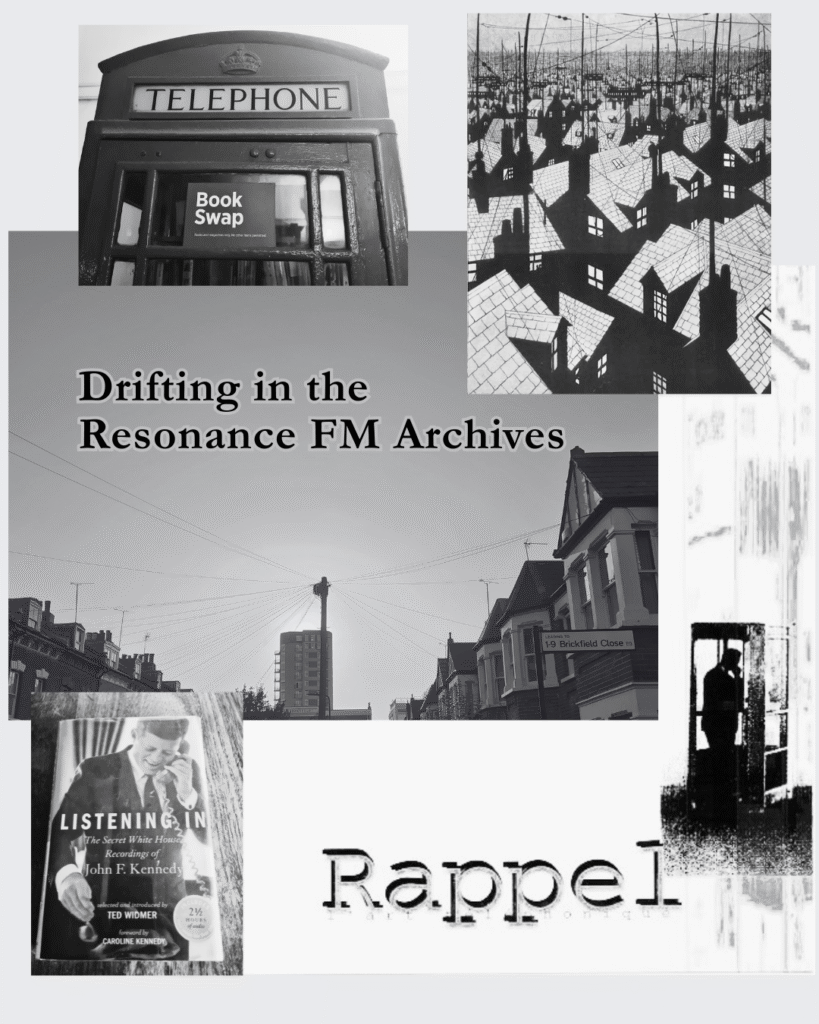
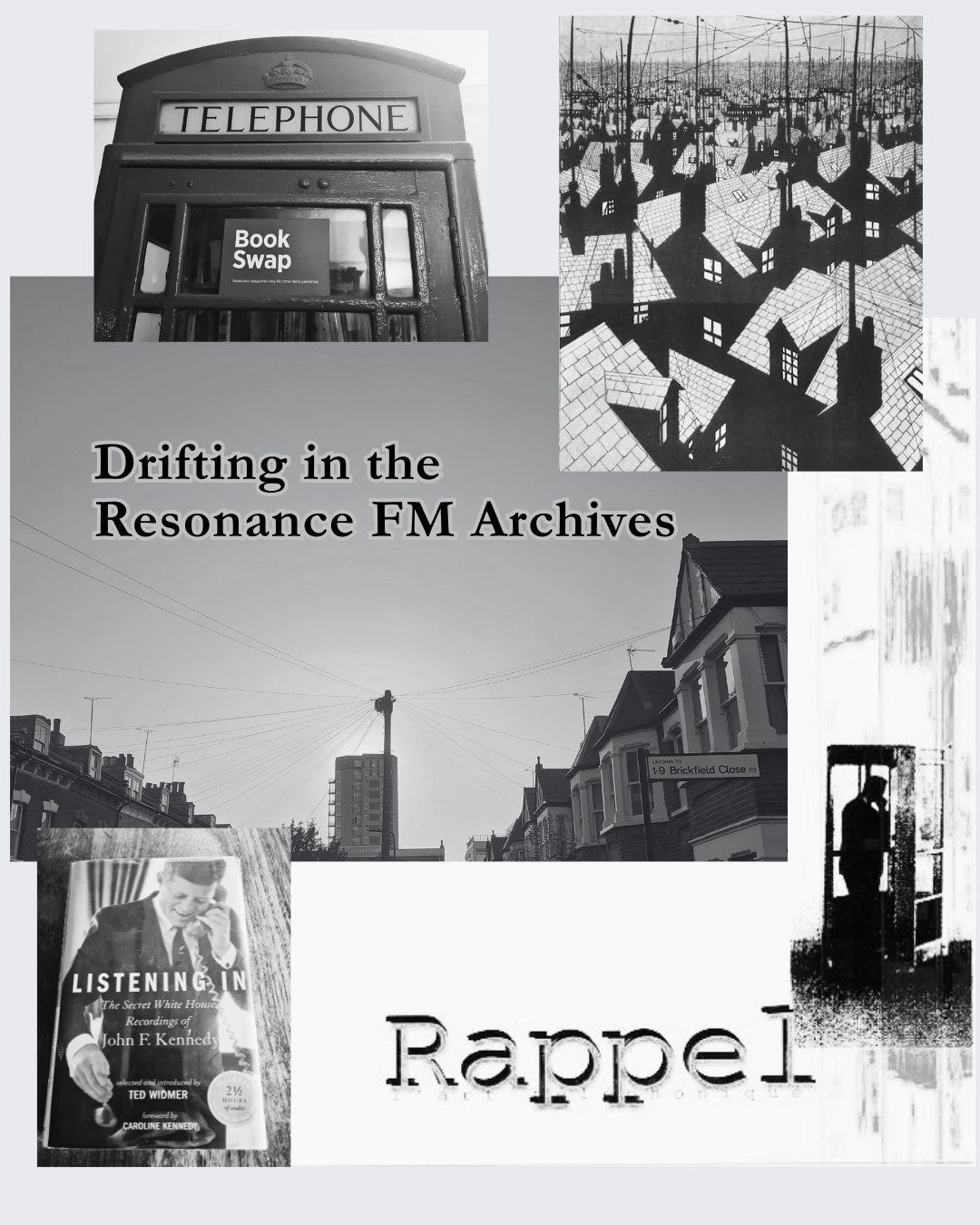
And here in London, where red telephone boxes are everywhere, one of the first I saw near my home has been turned into a book-swap kiosk – a free library.
When I see people approaching these little free libraries, these public bookcases, I tell myself that for a moment they have managed to change their state of mind, and that curiosity about which books are there has won out over the other concerns of the moment.
As if they had found a place of listening, a moment of attention.
One day, I opened the door of the red telephone box close to where I live and discovered a book entitled Listening In – The Secret White House Recordings of John F. Kennedy, with two cds.
* *
And here you can hear JFK speaking with former President Eisenhower on 28 October, 1962 – the day the world avoided nuclear war thanks to an agreement between John F. Kennedy and Nikita Khrushchev, exactly 64 years ago.
* *
Here, where I am, listening to the Resonance FM archives draws attention to the telephone line’s use value. The archives thus invite further reflection on this use value, particularly on the diversion and subversion of the telephone line’s function.
How many documents have I handled – or rather, lent an ear to – that allow us to hear different uses of, or experiences with, the telephone.
From the very first days of broadcasting at Resonance FM, in June and July 1998, experimentation was already underway.
Telephone lines enable transnational encounters, as I mentioned previously in the episode about London–Québec relations.
* *
And in 1998 there were also radio collaborations with the West Coast of United States, involving the Negativland collective.
* *
In the station’s early broadcasting hours in 1998, there was also another kind of experimentation with telephone lines, audiences, and radio.
* *
“Imagine if
dead air was punctuated
by occasional calls
from the hosts
who have become callers themselves
and who are walking through London
and are calling in from public booths
around the city.”
* *
“The ambience of the city leaking through each telephone booth creates a new portrait of the city through an electrocuted radiophone circuit” – the performance was also presented in these terms.”
In the Resonance FM archives, I also found a burned CD, on which is written “Answering Machine,” and which contains seven recordings. Here is the last of them, celebrating one of the time slots that has been part of the programming since the beginning: Clearspot, which allows everyone to propose a radio experiment.
* *
Thank you, Thank you Resonance
And yes, there are also listeners calling in with special requests.
* *
In the station’s early years, there was also, of course, Caroline Kraabel, doing a telephone experiment on her radio programme.
She was in France, walking with her daughter Régine and playing saxophone, all through a telephone line broadcast on Resonance FM.
* *
In this archive-as-playground – a potential space for reflection and for the idea of using the radio and the telephone line – here’s the Original Sound Track Show.
On every show, you could win a CD if you give an original answer to the question of the week by calling in.
* *
Who done it ? they done it, I mean we did it.
It was how I would answer to the question, as my mind is always thinking about archives and radio : Who done it, the archives, the radio, they are doing it, we are doing it.
* *
It’s impossible to talk about Resonance FM and telephone lines without naming Maurice Seddon — Captain Maurice Seddon.
A retired Royal Signals officer who became the friend of William English, a former radio producer of the show Wavelength on Resonance FM.
Maurice invented a particular telephone that operates on a one-way basis, making interruption impossible and conversation sometimes frustrating.
* *
And I wonder where all these cassettes are — surely at the home of his friend, William English.
* *
And as a matter of fact, I won’t investigate that case any further — it would be a marathon, like the one Resonance FM did in 2013 : The Seddon Tapes Marathon, a full 24 hours broadcast.
There’s plenty of other experimentation with the telephone line, here’s what I’ve found so far. I also found a CD called « Rappel – L’art téléphonique » that was released in 96 by Avatar in Quebec. On this disc you can hear Chantal Dumas, a sound artist who passed away last May. I discovered her by hearing this piece, where she calls every person who has the same name as her.
* *
We are all connected, one way or another – to the past, to the present, and to each other. There is something to unearth in the culture of both past and present. Digging below the surface of the archives, we can begin to grasp the many ways we have been connected – from telephone line… to archives now… – and how we relate.
* *
With the radio archives : Isotopica – 03 December 2017 – the telephone rings and someone speaks_.mp3